What Does “Unremarkable” Mean on a Medical Report?
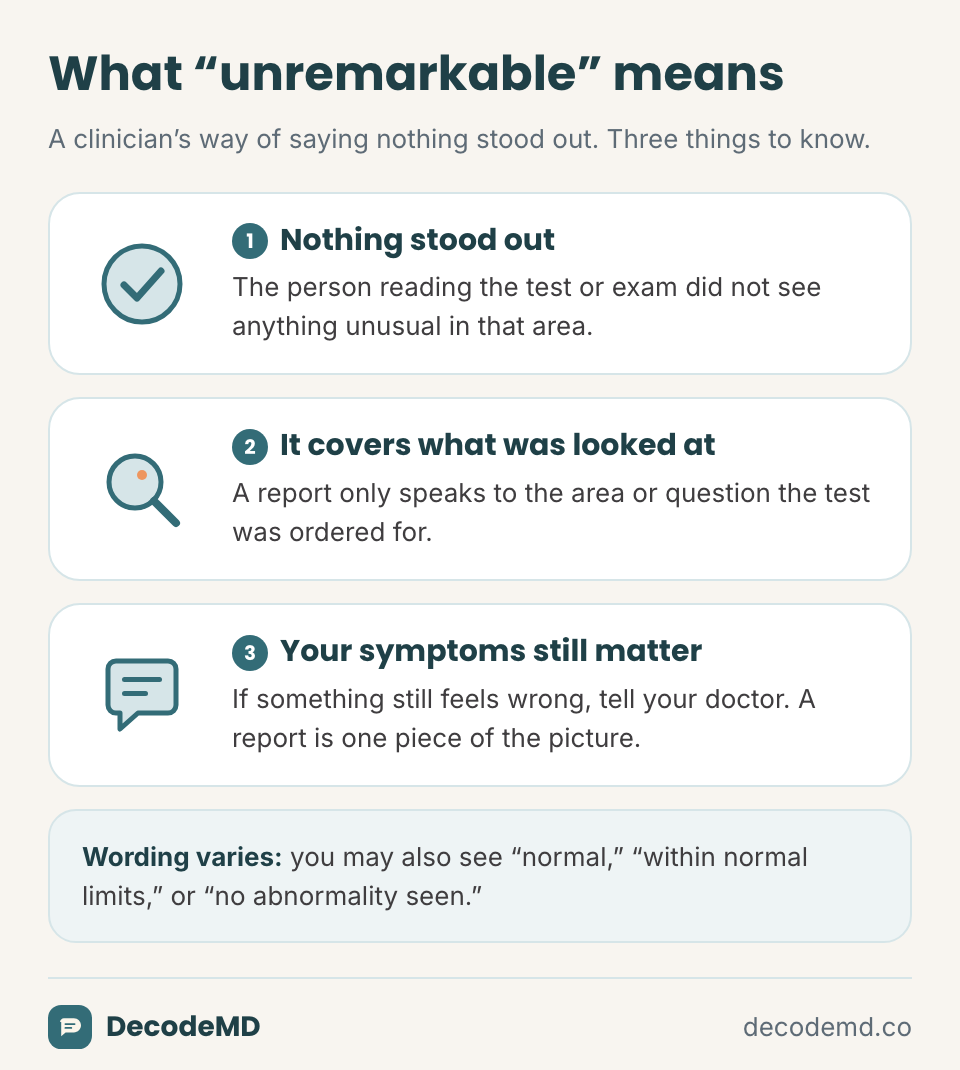
On a medical report, “unremarkable” means the person reading the test or exam did not see anything unusual. It is a clinician’s way of saying “nothing stood out.” It describes what was seen on that test, not your whole health.
If you are reading a parent’s report and the word jumped out, you are not alone. It sounds strange, and it can feel like it is hiding something. Here is what it means, where you will see it, and what to ask.
Why the word sounds odd
In everyday speech, “remarkable” means impressive. In medicine it has an older meaning: worth remarking on. So “unremarkable” simply means there was nothing worth pointing out in that area.
Think of it this way: a clinician is walking through a checklist. For each item, they either write down what is different or write “unremarkable.”
Where you will see it
- Imaging reports such as X-rays, CT scans, MRIs, and ultrasounds, often in the Findings section for each body area.
- Physical exam notes in a visit summary, for example a line about the heart, lungs, or abdomen.
- Other tests and procedure reports where a clinician describes what they saw, like an ECG or a scope.
Wording varies by clinic and by clinician. Some write “unremarkable,” others write “normal” or “no abnormality seen.”
What it does and does not tell you
What it does tell you
- For that body area or that test, the reader did not note anything unusual.
What it does not tell you
- That nothing is going on. Every test has limits. A scan can only show what it is able to show.
- That the test looked at everything. A report only covers the area or question the test was ordered for.
- That your symptoms do not matter. If something still feels wrong, say so. A report is one piece of the picture.
It is also worth reading the rest of the report. A line can say “unremarkable” while another section lists a smaller finding. On imaging reports, the Impression section is the summary. See how to read the Impression on an MRI report.
Similar phrases and what they usually mean
| Phrase | In plain English |
|---|---|
| Unremarkable | Nothing stood out to the reader. |
| Within normal limits (WNL) | A measurement fell inside the expected range. |
| No acute findings | No sign of something sudden or recent was seen. Older or long-standing findings can still be listed. |
| Negative | The test did not find what it was looking for. |
| No evidence of | The thing named was not seen on this test. |
| Stable | Unchanged compared with an earlier test. |
Questions to ask your doctor
- Does “unremarkable” cover the area where I (or my parent) have symptoms?
- Does this test rule out what we were worried about, or only show that it was not seen?
- Is anything else on the report worth knowing about, even if it is minor?
- If the symptoms continue, what would be the next step?
- Should this be compared with an earlier test?
Paste your report into DecodeMD and get it in plain English
DecodeMD explains every line on your report, including words like unremarkable, with the questions worth asking ready for your next visit.
Frequently asked
Does unremarkable mean normal?
Close, but not identical. "Within normal limits" means a measurement fell in an expected range. "Unremarkable" is a broader note that nothing stood out to the person reading the test or exam. Your doctor can tell you what is normal for you.
Is unremarkable good news?
It is often the result people hope for, but the word only describes what was seen on that test or exam. It does not describe how you feel or what comes next. Your doctor connects it to your symptoms and history.
Can a report be unremarkable and still need follow-up?
Yes. A report can say nothing stood out, and a doctor may still suggest more tests if symptoms continue or if the test could not answer the question. Ask what happens next and what would change the plan.
Want to learn more? See the MedlinePlus Understanding Medical Words tutorial.
Reading the rest of the report? Start with how to understand your lab results.
DecodeMD explains report language in plain English. It does not diagnose, and it does not replace your doctor or care team.